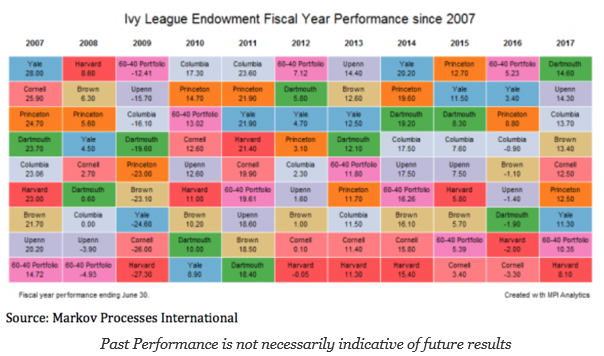
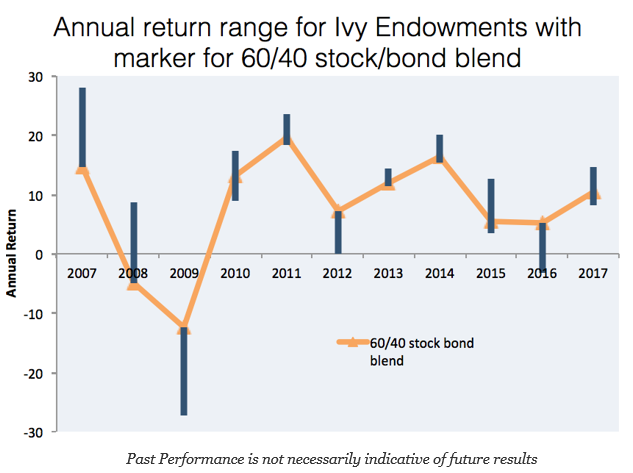
The latest performance numbers for Ivy League endowments have been nicely displayed in the chart below along with the 60/40 stock/bond portfolio. Since the development of the “endowment” model associated with Yale and the attention on Harvard, the largest endowment, there has been an unusual focus on these funds. There is a fair amount of dispersion between the best and worst managers in the group.
Nevertheless, investors can compete against these more sophisticated funds by even just holding some variation on the 60/40 stock/bond mix. Three of the last ten years have seen the 60/40 mix at the top of the rankings. Twice the 60/40 mix has been at the bottom of the grouping.
A large portion of the Ivy endowments has been associated with illiquid private equity investments. The 60/40 stock/bond investment blend is a liquid portfolio. It is possible that adding liquid assets that have higher returns than bonds or further diversification characteristics can generate more competitive returns to a simple 60/40 mix. A liquid investment strategy approach can compete with more sophisticated managers.
After hundreds of discussions with hedge fund managers, I am still surprised that there is a fear of revealing investment processes under the assumption that someone will steal their ideas and intellectual capital. There are few investment styles that are truly unique and special. What is special is still strategy execution – the practical process of delivering returns. Skill is with the decision-making execution of information and strategy.
All hedge funds are not created equal as the return box chart shows for the post Financial Crisis period. There is a significant amount of dispersion across hedge fund styles. Over the period 2009-2018, the difference between the best and worst hedge fund category is almost 7 percent after we account for global equities and bonds.
The attraction to private equity and other less liquid alternatives is clear from the Guide to Alternatives by JP Morgan Asset Management. The return profile is much higher for private equity and debt funds than more liquid alternatives and global bonds; however, the dispersion in returns is multiples higher than what can be expected from other public categories.