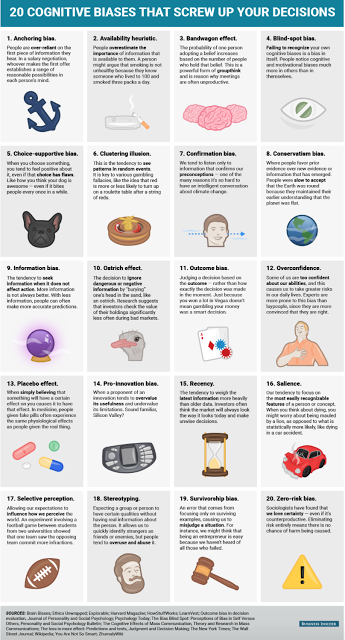
The behavioral finance revolution has been well noted by both academics and practitioners. Multiple Nobel Prizes have gone to economists who have studied in this area, yet investment decision-makers still make the same behavioral mistakes. We have noted our biases but often we have not changed our behavior. Perhaps it is too ingrained, but good has to be reinforced.
The following info graph does a nice job of listing the possible mistakes (screw-ups) that can be made. Only 20? Without a review or inventory of your mistakes, there is little chance for decision improvement. If there is a performance review for a portfolio, it seems as though a performance review of decisions should also be made.
How many decisions were made in the last month? How many were good ones? A good decision does not have to be profitable. It does have to be rational. In many ways the decision-making review for a quant system is so much easier because the behavior is hard-coded in the action. Nevertheless, discretionary decisions can still be made more rational and address a unique set of problems. A decision review system will help.
After hundreds of discussions with hedge fund managers, I am still surprised that there is a fear of revealing investment processes under the assumption that someone will steal their ideas and intellectual capital. There are few investment styles that are truly unique and special. What is special is still strategy execution – the practical process of delivering returns. Skill is with the decision-making execution of information and strategy.
All hedge funds are not created equal as the return box chart shows for the post Financial Crisis period. There is a significant amount of dispersion across hedge fund styles. Over the period 2009-2018, the difference between the best and worst hedge fund category is almost 7 percent after we account for global equities and bonds.
The attraction to private equity and other less liquid alternatives is clear from the Guide to Alternatives by JP Morgan Asset Management. The return profile is much higher for private equity and debt funds than more liquid alternatives and global bonds; however, the dispersion in returns is multiples higher than what can be expected from other public categories.