Category: Decision-Making
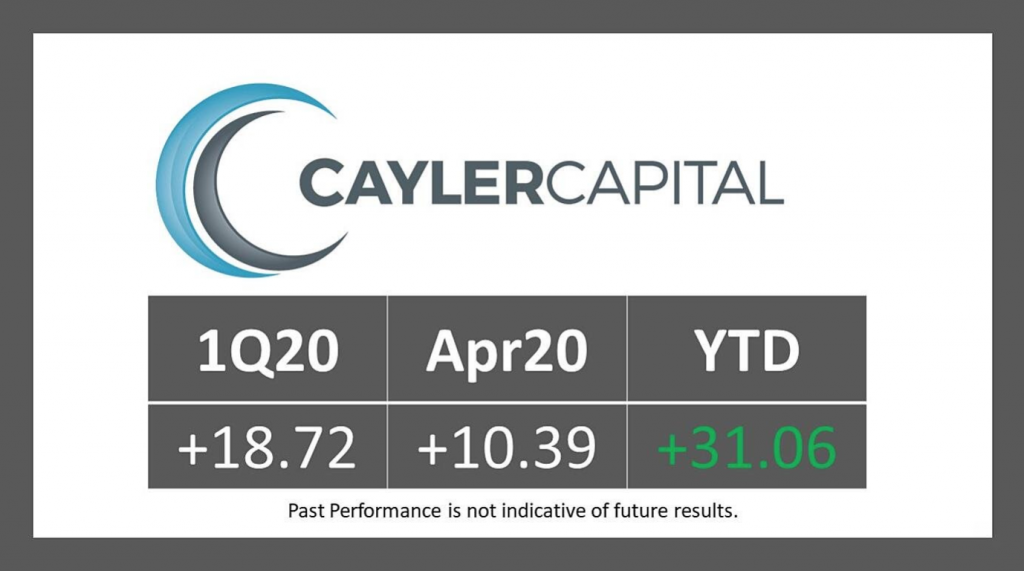
Cayler Capital | April Performance Commentary
After finishing off one of the wildest quarters of my trading career, April managed to take the cake. For those that missed it (not sure how you possibly could have), oil settled negative $37. The effects of this were immediate: risk barometers had to be recalculated, option models switched, and most importantly was the immediate […]

Mike Lombardi, football coaching and investing
I am not a football fanatic, but I picked up this book on a recommendation and was amazed by Lombardi’s insights on leadership and management. Mike Lombardi is long-time football executive and media analyst. The book focuses on Bill Belichick and the New England Patriots, but his conclusions could apply to any money management firm. A good money management firm is successful because it acts like a well-disciplined organization with a common purpose. That is no different than a competitively run sports organization. Lombardi finishes his book with five key recommendations for firm success that are worth presenting in bold.
“The Emeril Lagasse Theory” – Practical knowledge and culture is not often transferable
After hundreds of discussions with hedge fund managers, I am still surprised that there is a fear of revealing investment processes under the assumption that someone will steal their ideas and intellectual capital. There are few investment styles that are truly unique and special. What is special is still strategy execution – the practical process of delivering returns. Skill is with the decision-making execution of information and strategy.
Microcosm versus Macrocosm – The impact of your mental model in decision-making
Every investor has a mental model of how the world works. Some may call this their philosophy. Other will call this their belief system. These mental models form their rational expectations or rational beliefs. They are rational because they are consistent with the mental model being employed. These beliefs should be unbiased. If they are not, it requires the investor to adjust their model to eliminate the bias.
A “Playbook” versus “Rulebook” and reaction to uncertainty
How do you deal with uncertainty? Some will suggest following rules. Disciplined and systematic investing is the best way to deal with the unknown because there is specific action regardless of the environment. Others argue for flexibility. Unknown or surprise events require special action. When faced with uncertainty, it may be best to adapt and adjust to the specific situation. Arguments can be made for both.
Cognitive Priming and Trend-following – Not a Bad Thing
Cognitive priming is a real effect that has often not been discussed with investment decisions and behavioral finance. Suggestions can be used to steer the behavior of investors. Priming is the use of stimulus to create a memory effect or create a temporary increase in accessibility of thoughts and ideas. It is the non-conscious use of memory. It could be used to increase both positive and negative thoughts, ideas, and behavior. Businesses have constantly used priming in advertising to help steer or suggest positive memories. Psychologists have tested priming for years and find that the power of suggestion or linkage is real and extensive. At the extreme, think of Christopher Nolan’s movie Inception on the idea of implanting ideas in memory.
Be a Coach Belichick 5-tool Investment Leader
He (Bill Belichick) is a five-tool leader, adept at strategy, tactics, preparation, execution, and what you might call situational intuition, the rare ability to know which among the first four is required and when.
Maximizing Investment Success: A Guide to Developing and Weighing Multiple Options
Paul Nutt, a leading decision-making researcher – Only 15% of the case studies saw decision-makers actively seek out new options than what was available at the outset. Only 29% of organizational decisions contemplated more than one alternative. (From Farsighted by Steve Johnson) There is more to decision-making than “whether or not”. Too often, decision-making is bereft of choices. Everything […]
Surviving Market Turbulence: Why Yesterday’s Logic Won’t Cut It
Market turbulence just does not happen. There is a catalyst, and the catalyst is a surprise turn of events. Now there are investment surprises everyday, the difference between expectations and realized results. A surprise creating market turbulence is more than just a micro surprise associated with a company but is a signal of a macro regime change.

The fallacy of extrapolation – A deficiency of forecast imagination
One of the great problems with forecasting is the fallacy of extrapolation. Forecasters love to believe that tomorrow will be like to today and head in the same direction. Whatever is the trend today will continue tomorrow to the exclusion of other alternatives. There is over-extrapolation.
Naturalistic decision-making permeates investment world
Gary Klein is one of the great researchers in practical decision-making; however, he has been overshadowed by the behavioral bias revolution and the more popular work of Nobel prize winner Dan Kahneman. That is unfortunate and should be rectified. Klein focuses on naturalistic decision-making; the fact that decision-making in real life is significantly different than anything in a controlled environment.
Premortem for decision-making – Better than waiting for the decision postmortem
All investors and traders want to get better as decision-makers. They are open to learning and improvement, and a natural way to gain this improvement is through reviewing their actions after the fact. The old adage is that we will learn from our mistakes. If you have a thorough review process, you can form an effective feedback loop to ensure future decisions will not be driven by the mistakes of the past.
The limits of investment stories – Better to have a sample of data
I have an anecdote, but not an antidote, for whatever ails you; that is the problem. Stories or tales of past economic events do not solve investment problems. Investment tales may persuade as a device for action. They may provide useful background information, but they do not provide the basis for an effective solution.