
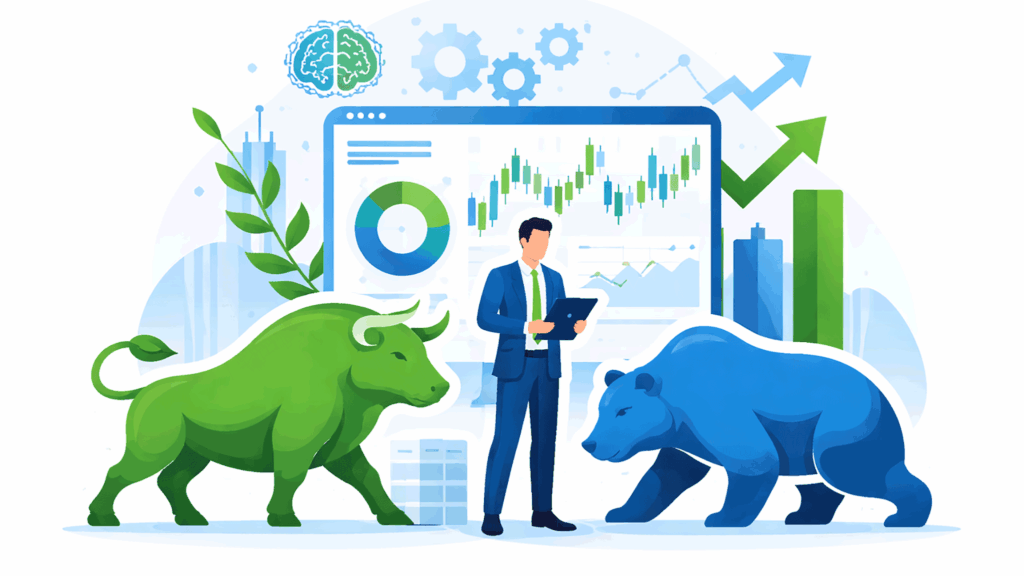
Investors face many choices when selecting investments. Historically, the main divide was between fundamental and technical trading. The growth of computer systems for trading has introduced a potentially larger variable that will only increase as AI advances, whether in systematic (rules-based) or discretionary (human judgment) trading. In just my 20 years working in the industry, the shift towards automation has been dramatic. Many of the most successful programs on IASG for 2025 were discretionary, however. Both methods have advantages and disadvantages. Which one is right for you?
Risks and Limitations of Systematic Trading
Taking human emotion out of trading is the key tenet of systematic trading. The psychological aspect of losing money and then re-entering another position immediately cannot be overstated. One discretionary CTA of ours would not trade on Friday afternoons. He knew that a loser would ruin his weekend. He preferred to wait until Monday and start over again with a clear head. Computers do not feel any pain when they err. They just repeat the same process, with the underlying logic built in to repeatedly trade their edge. This enables back-testing the logic against historical market patterns to find this advantage. Looking backwards is easy, though. When a simulated return is too good, we assume that there is overfitting. Parameters were over-optimized to achieve the desired result. The real world is not consistent. Regime shifts can change everything, whether a bubble bursts or a policy changes.
We all see that the speed of information dissemination continues to increase. News from Europe or Asia ripples through US markets almost in real time. For my discretionary CTAs, I often ask what happens if something occurs in the middle of the night. Responses vary. Some use alarms to wake up and begin trading. Others use stops or third parties to execute pre-set reactions to events. These events can hit any market. In late January 2026, silver dropped 34% intraday. A system can look across hundreds of contracts at once and react immediately without being overwhelmed. Trend followers, the classic example of systematic trading, often consider over 120 commodities or financial futures positions to identify opportunities. In many years, just a few trades make up the majority of their profit or loss.
Discretionary Trading: Human Judgment in Action
These traders would argue that we do not drive by looking in the rearview mirror. Just because a pattern existed in prior years does not guarantee that the future will look the same. Computer systems do their best in predictable environments where directional trades can be held for longer periods. They are often not great at reacting to novel or surprising situations. After all, the adage goes that “markets can be illogical longer than you can remain solvent.” The idea that moves need to make sense has been disproven throughout history. Humans react, often out of emotion or fear. This creates irrational swings that can help or hurt a position. It is here that getting stuck on an opinion or letting your own biases drive positioning can affect decisions. Recognizing that personal emotions might affect your ideas or ability to think clearly is key.
On the positive side, discretionary traders can now plan around Fed meetings or anticipate a Trump press conference. A system rarely takes these types of events into account. Leadership changes, Fed influence on the markets varies, and policy provisions in the 90s look much different from what they do currently. In 2008, the mortgage crisis unfolded slowly, which gave systematic traders an edge. Despite that, the day that TARP (Troubled Asset Relief Program) passed, with its $700 billion to purchase impaired assets, the S&P surged 11.58% in a single day. This went against every trend and most positioning, causing large daily losses. Recently, the April 2, 2025, “Liberation Day” announcement of broad reciprocal tariffs triggered sharp market swings and reversals, punishing trend-following positions in ways that discretionary managers could potentially sidestep or anticipate. Unlike a computer, they can decide to sit flat entirely, which is often a wise choice.
Systematic vs. Discretionary Performance: 2025 IASG Data
Our IASG Indices showed positive results for systematic and discretionary trading last year. The Discretionary Trader Index edged out the Systematic Index with an 8.59% return compared to a 4.50% gain, respectively.
The table below summarizes the core differences between systematic and discretionary trading strategies.
| Aspect | Systematic | Discretionary |
|---|---|---|
| Emotion removal | High | Low |
| Backtesting | Strong | Limited |
| Adaptability to novel events | Lower (unless adaptive models) | Higher |
| Scalability | High (across many markets) | Lower (human-dependent) |
| Consistency | More predictable profile | Varies by manager |
The Role of Artificial Intelligence in Trading
The promise of an AI-driven algorithm is that it will combine the best of both worlds. The consistency of a computer but the adaptability of a person. Even with advanced technology, a human element is required. What is the risk tolerance per trade? How often will it make decisions? Theoretically, it could make thousands of trades a minute, but the costs of that volume would be astronomical in exchange fees alone. Generating too many signals/false positives is often the problem we hear when dealing with these learning systems. My guess is that we will see a blending of ideas, with multiple systems and/or human input. This combination will create unique and persistent results. No matter the path, constant evolution will be required.
Building a Diversified Managed Futures Portfolio
Every level of futures trading uses technology at some level. How much you trust your portfolio to these systems is different for each customer. I often advise customers to identify a core holding and then add diversification around that central pillar. Most often, that program is systematic. These companies approach the market the same way all the time, and while they do not always work, their profile is fairly consistent across different types of market cycles. Discretionary traders provide unique alpha but can be less predictable as their view on opportunities will vary greatly over time. Specialists in agriculture, including grains and meats, lend themselves more to this type of trading. If you value consistency and diversification, systematic might be the choice for you. If you think the news will be driving direction going forward, discretionary might be the best option to help your portfolio. As always, diversification is key. Many successful IASG portfolios blend both for optimal risk-adjusted returns.
FAQs
What is the difference between systematic and discretionary trading?
Systematic trading uses predefined rules and algorithms to generate and execute trades automatically. Discretionary trading relies on human judgment to interpret market conditions and make real-time decisions.
The main difference is that systematic trading removes emotion and follows consistent logic, while discretionary trading allows flexibility and contextual interpretation of news, policy changes, and market sentiment.
Which is better: systematic or discretionary trading?
Neither approach is inherently superior.
Systematic trading often provides consistency, discipline, and diversification across many markets. Discretionary trading may offer greater adaptability in fast-moving or news-driven environments.
Many investors choose to blend both approaches within a managed futures portfolio to improve risk-adjusted returns.
Illustration created by ChatGPT (OpenAI / DALL·E)
Related Posts
How to Find the Right Managed Futures Programs on IASG
Having many options when choosing an investment manager is a great advantage. However, filtering through hundreds of programs to find the ones that best match your needs isn’t always easy. With hundreds of CTAs in our database, a few simple strategies can make the search process much more efficient. Here are the approaches I use […]
Race to Nowhere: Markets Pause Before the Next Big Move
Running on a treadmill is one of my least favorite activities: you expend a lot of energy but end up exactly where you started, only out of breath. So far in 2026, financial markets are behaving similarly. There’s intense activity, but the major indices have gone almost nowhere. As of mid-February, the S&P 500 is […]

Bowmoor Capital – A Different Approach to Trend Following
Competing head-to-head to outsmart others doing the same strategy is often a tough road. In trend following circles, giants like Man AHL, Winton, and Aspect dominate assets under management. This enables them to hire top PhDs, deploy better technology, test ideas rapidly, and outspend smaller players on sales and marketing. So how can a smaller […]