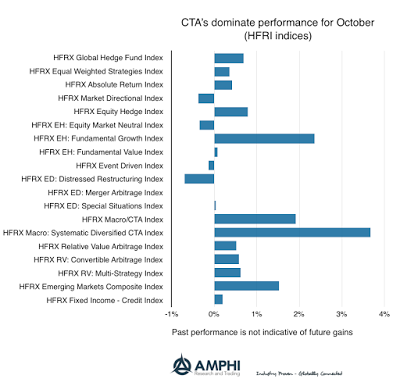
CTAs showed their strongest performance of the year in October. Only the fundamental growth strategy came close to generating the returns seen in managed futures for the month. Some strategies actually posted losses for October even with the continued increase in equity returns.
Managed futures will do best when there are trends outside the normal equity bond mix. With increases in the dollar, energy complex, and selected commodities, CTA’s were able to find profitable opportunities.
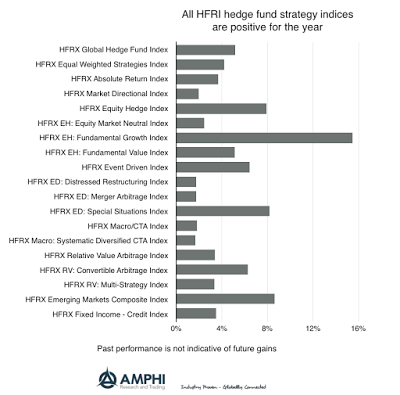
All hedge fund strategies are now posting positive returns for the year. The best returning strategies are fundamental growth, special situations, and emerging markets. Most strategies have some combination of beta and alpha generation; consequently, the strong absolute gains in equities help hedge funds with performance.
After hundreds of discussions with hedge fund managers, I am still surprised that there is a fear of revealing investment processes under the assumption that someone will steal their ideas and intellectual capital. There are few investment styles that are truly unique and special. What is special is still strategy execution – the practical process of delivering returns. Skill is with the decision-making execution of information and strategy.
All hedge funds are not created equal as the return box chart shows for the post Financial Crisis period. There is a significant amount of dispersion across hedge fund styles. Over the period 2009-2018, the difference between the best and worst hedge fund category is almost 7 percent after we account for global equities and bonds.
The attraction to private equity and other less liquid alternatives is clear from the Guide to Alternatives by JP Morgan Asset Management. The return profile is much higher for private equity and debt funds than more liquid alternatives and global bonds; however, the dispersion in returns is multiples higher than what can be expected from other public categories.