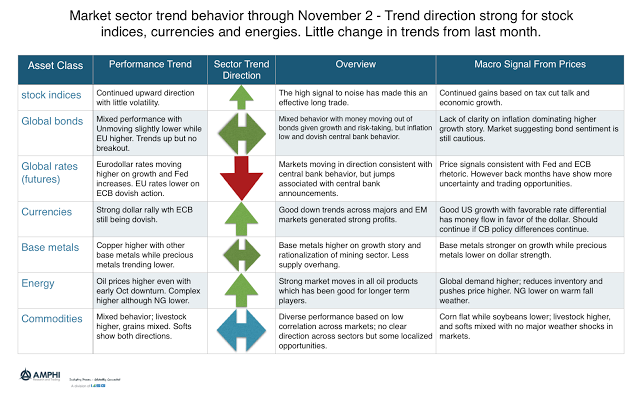
You could call it the second reflation trade. Based on economic data trends which suggest stronger global growth coupled with tax reform/cut talk, we are seeing major sectors show increasing trends and opportunities. The good October trends seem to be carrying over to November. The reflation trades has driven stock indices, energy, and base metals prices higher. The differential between monetary policy in the US and the rest of the world also suggests dollar strengthening. The rate differential is in favor of the dollar. This dollar strength places downward pressure on precious metals. Bond price behavior has been a little surprising with some recent gains in spite of the strong growth story.
Our general view is that October trends will continue given current price action relative to different trend timeframes and break-out models.
After hundreds of discussions with hedge fund managers, I am still surprised that there is a fear of revealing investment processes under the assumption that someone will steal their ideas and intellectual capital. There are few investment styles that are truly unique and special. What is special is still strategy execution – the practical process of delivering returns. Skill is with the decision-making execution of information and strategy.
All hedge funds are not created equal as the return box chart shows for the post Financial Crisis period. There is a significant amount of dispersion across hedge fund styles. Over the period 2009-2018, the difference between the best and worst hedge fund category is almost 7 percent after we account for global equities and bonds.
The attraction to private equity and other less liquid alternatives is clear from the Guide to Alternatives by JP Morgan Asset Management. The return profile is much higher for private equity and debt funds than more liquid alternatives and global bonds; however, the dispersion in returns is multiples higher than what can be expected from other public categories.