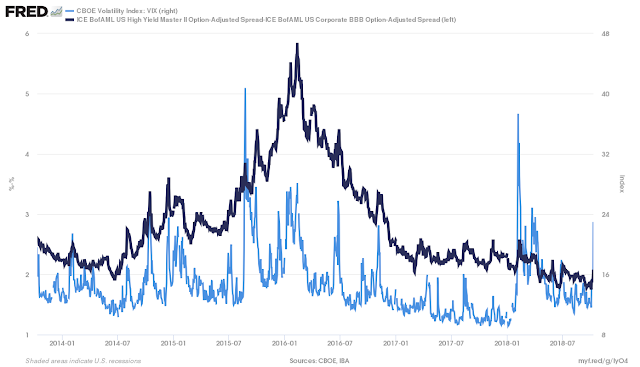
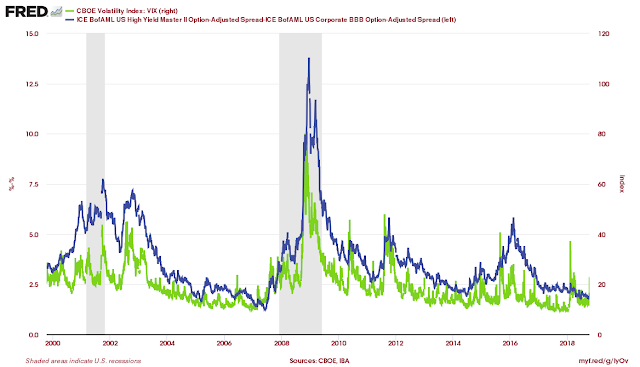
Volatility has spiked higher with the decline in equities, but there are also volatility effects on other markets. Using a Merton debt framework, corporate bonds can be thought of as a risk free bond and a short put position on the value of the firm minus its liabilities. Hence, if market volatility increases as measured by the VIX, there should be an increase in corporate spreads. Additionally, the spreads should increase more for highly levered firms or firms that have higher risk such as those represented in the high yield market. This increase in spreads is related to the increase in the volatility of the value of the firm and not the volatility of interest rates or call features which will be incorporated in the option-adjusted spread.
Looking at the spread between high yield and BBB bonds through the BAML bond indices shows that recent volatility spikes have translated into wider spreads. This spread widening on spikes has generally been temporary and revert with volatility declines but longer-term increases in volatility do translate to higher sustained spread levels. Corporate credit may not be as safe as evidenced in recent data if volatility stays higher.
After hundreds of discussions with hedge fund managers, I am still surprised that there is a fear of revealing investment processes under the assumption that someone will steal their ideas and intellectual capital. There are few investment styles that are truly unique and special. What is special is still strategy execution – the practical process of delivering returns. Skill is with the decision-making execution of information and strategy.
All hedge funds are not created equal as the return box chart shows for the post Financial Crisis period. There is a significant amount of dispersion across hedge fund styles. Over the period 2009-2018, the difference between the best and worst hedge fund category is almost 7 percent after we account for global equities and bonds.
The attraction to private equity and other less liquid alternatives is clear from the Guide to Alternatives by JP Morgan Asset Management. The return profile is much higher for private equity and debt funds than more liquid alternatives and global bonds; however, the dispersion in returns is multiples higher than what can be expected from other public categories.