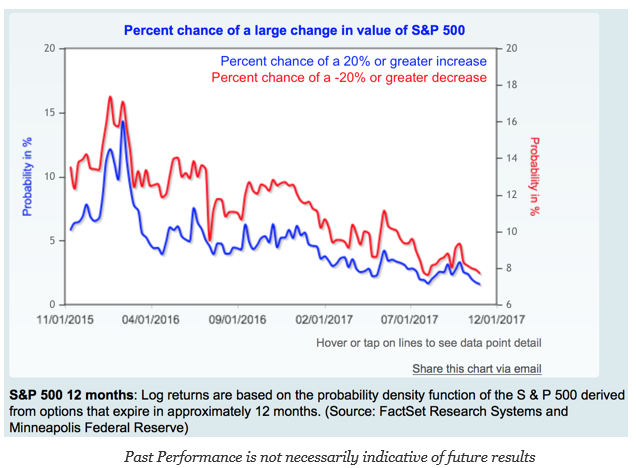
From the Minneapolis Fed we have market-based probabilities of a large up or down market move embedded in 12-month options. This is a good market-based view of a large up or down stock market move.
If we look at the numbers from a year ago, the probability of a 20% or more down move was more than double the chance of a 20% up move over the next year; (13% versus 5%). Now, the chance of a 20% down move is approximately 8% and the chance of an up move is about 2%. The market has a tighter range but the change of a down move is still much higher than an up move. There is still skew to the downside but likelihoods have fallen.
These volatility numbers will be tied with market moves, but right now it is hard to argue that there will be a large market moves given the chance of 20% down move has declined by close to 40% and a chance of an 20% up move has dropped by over 50%.
After hundreds of discussions with hedge fund managers, I am still surprised that there is a fear of revealing investment processes under the assumption that someone will steal their ideas and intellectual capital. There are few investment styles that are truly unique and special. What is special is still strategy execution – the practical process of delivering returns. Skill is with the decision-making execution of information and strategy.
All hedge funds are not created equal as the return box chart shows for the post Financial Crisis period. There is a significant amount of dispersion across hedge fund styles. Over the period 2009-2018, the difference between the best and worst hedge fund category is almost 7 percent after we account for global equities and bonds.
The attraction to private equity and other less liquid alternatives is clear from the Guide to Alternatives by JP Morgan Asset Management. The return profile is much higher for private equity and debt funds than more liquid alternatives and global bonds; however, the dispersion in returns is multiples higher than what can be expected from other public categories.