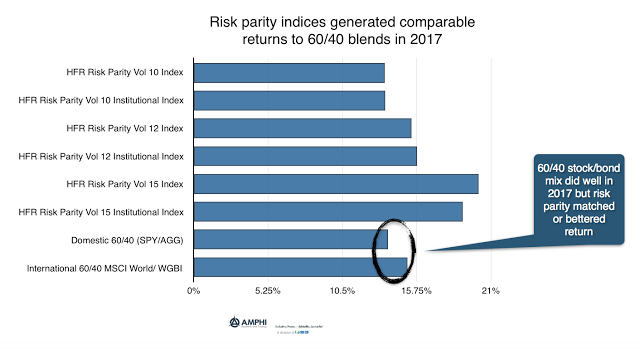
The 60/40 stock/bond blends both domestic and international generated double-digit returns on strong equity performance. The majority of the risk came from the stock allocation which make them sensitive to any market reversal.
Risk parity programs as measured by the HFR index series also provided good returns in 2017 with performance that matched or bettered the more traditional dollar weighted portfolio. This risk parity approach offers an alternative asset allocation weighting scheme in an overall market where equities are overvalued.
We have argued that risk parity has some macro flaws. These programs will be sellers in a risking volatility market which may create negative feedback loops, but the idea of allocating across a broader set of asset classes and employing schemes that move away from asset class dollar weighting have merit. Most global macro and managed futures have risk parity features which ensure asset class diversification.
After hundreds of discussions with hedge fund managers, I am still surprised that there is a fear of revealing investment processes under the assumption that someone will steal their ideas and intellectual capital. There are few investment styles that are truly unique and special. What is special is still strategy execution – the practical process of delivering returns. Skill is with the decision-making execution of information and strategy.
All hedge funds are not created equal as the return box chart shows for the post Financial Crisis period. There is a significant amount of dispersion across hedge fund styles. Over the period 2009-2018, the difference between the best and worst hedge fund category is almost 7 percent after we account for global equities and bonds.
The attraction to private equity and other less liquid alternatives is clear from the Guide to Alternatives by JP Morgan Asset Management. The return profile is much higher for private equity and debt funds than more liquid alternatives and global bonds; however, the dispersion in returns is multiples higher than what can be expected from other public categories.