Category: Economics
Alan Krueger and the Tough Problem of Happiness
Everyone who has taken a course in economics is aware of utility theory and the desire to have more “utils”. Those with a historical focus will recall the deep discussions of early 19th century economist, “utilitarians” and the dismal science. The concept of measuring and auditing happiness has resurged in economic research, but it has been a perplexing problem. The basic idea with both economics and finance is that money can buy you happiness, but the reality is more complex.
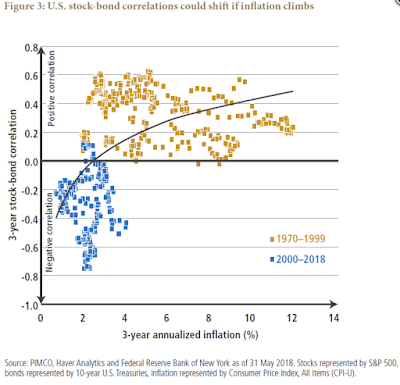
When Inflation Moves Higher – What To Expect With The Stock-Bond Correlation
The single largest diversification play for investors over the last two decades has been the strong negative correlation between stock and bonds. There are portfolio managers and investment analysts who have spent their entire career under the negative stock-bond correlation advantage, yet times change. Finance’s greatest “free lunch” is not a one-sided bet. Older managers can impress young analysts even in their forties of old tales of “back in the day” when stocks and bonds moved together. Some may argue that elders who talk of this should be retired and just let the new guys run things, but investors should discuss and prepare for alternative equity/bond environments.
How to Build Effective Economic Models – Translate to a Narrative and have Examples
a good mathematical theorem dealing with economic hypotheses was very unlikely to be good economics; and I went more and more on the rules

The Power Law and Hedge Funds – Power Law in Size May Not Equal Power Law in Returns
The four biggest hedge fund launches of 2018 have attracted more than $17bn, according to figures compiled by the FT. That compares with the $13.7bn investors have put in existing funds, according to data from eVestment. from FT Hedge fund stars rake in billions for new funds
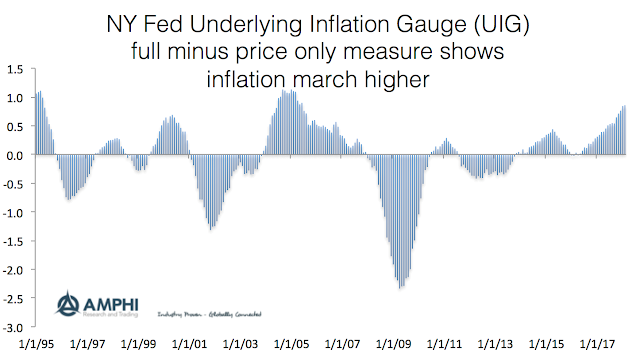
Inflation is Here – Now Focus on the Next Question, Where is it Going
Inflation is here. There is no doubt, but that number will be around 2%. The only question that is unclear is whether there will be overshoot beyond the 2% level. Clearly inflation in the Eurozone is still not near 2%, but all inflation placed bets seem to surround the target level that have set by central banks. Investors have to ask the simple question of whether the beyond 2% is realistic.

Oh My Bonds
“Oh my god, the unemployment rate is below the natural rates, sell your bonds!”
This has been the usual bond market reaction for the last few decades, but the world has changed. There may be good reasons to sell bonds, but a low unemployment rate may not be the main driver. Investors need to kill off the idea of the natural rate of unemployment or at least modify their views. That does not mean that bonds will not react to low unemployment rates, but the current sensitivity is significantly different than what we have seen in the past.
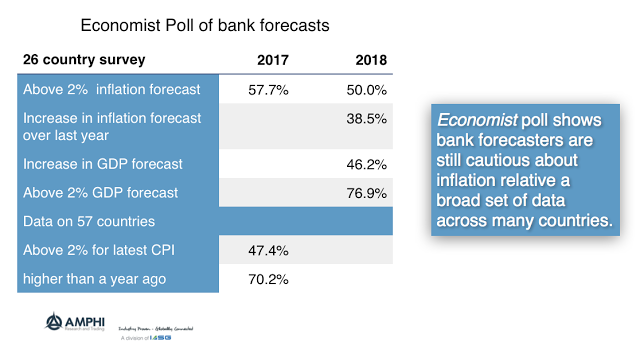
Still Caution with Inflation Forecasts Even If Trends Are Higher – Big Question Is Whether You Bet Against the Caution
Inflation is becoming a greater concern with many investors, but forecasters are more mixed with their views. The latest CPI number posted a 2.1% year over year change and the core CPI showed a 1.8% change. CPI has been above 2% for 8 of the last 12 months; however, both the CPI and core CPI changes were higher last January. These numbers are stabilizing at a higher level around 2% although there is not a run-away threat with the actual numbers or market expectations.
Richard Thaler – Nobel Prize Winner – The Economist Who Provides a Foundation for Rules-Based Managed Futures
We congratulate Richard Thaler on winning this year’s Nobel Prize in Economics. His relentless research on the failings of rational behavior in human decision-making has had a significant impact in finance and economics. His prolific work is the foundation for all of what we call behavioral economic and finance. Prior to Thaler, economist focused on Homo Economicus, the rational man that does not make mistakes or misjudgments. Thaler showed through test after test that we make mistakes and have biases. He did this albeit radical work not as an outsider to finance like Dan Kahneman but as a economist steeped in the neoclassical tradition.

Bubbles Are Everywhere if You Know How to Look for Them
Markets have been known to move to price extreme which have often been referred to as bubbles. The best know of these bubbles have been noted to lead to large market dislocations in both financial markets and the real economy. The “dot com” and housing bubble are the best known most recent examples, but unfortunately, there has not been much agreement on what are identifiable characteristics or the cause of these bubbles. While there can be agreement that bubbles are related to positive feedback loops, there is little work on a method for filtering data through some general model that will define a bubble.
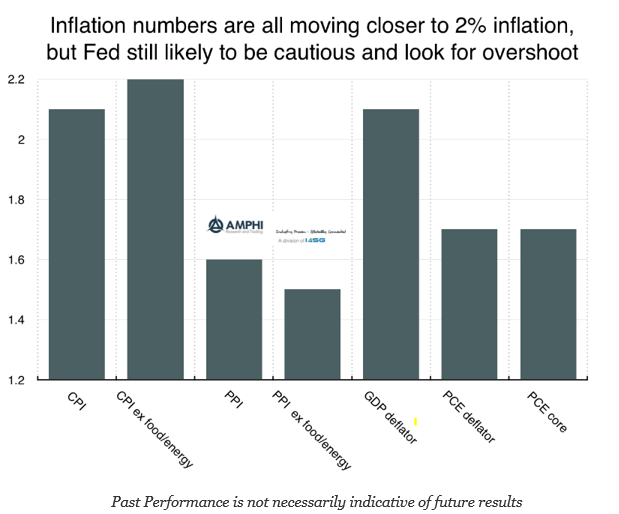
Inflation Closing in on Magic 2% or Bouncing Back
Current inflation numbers are all moving closer to 2%, but there is no special policy action from hitting or exceeding this rate. In fact, a cautious Fed is more likely with the most aggressive forecast being 2-3 rate moves. The Fed has not followed a mechanistic policy even though they have stated they are “data driven”. The most likely forecast will be to fade the earlier musings of the Fed.

From Populism to Macro Policy: The Regime Change of 2017?
Our commentary for the new year is not filled with predictions but describes an uncertain world of extremes for 2017. This uncertainty exists because the rise of populism seen in 2016 will have to be converted into macro policies during 2017.

Yield Trends Started Well Before Election
Yields exploded on the upside after the election and has seen one of the largest routs in recent years, yet it would be wrong to believe that this is all associated with the election. A close look at the trend sin yields show that the market broke above moving averages at the end of September. Using simple moving averages (20, 40, and 80-day), we would have called a change in bond sentiment weeks ago.

Commodities – Is This the Time to Allocate?
Commodities have been an out of favor asset class. With a long-term return downturn, that has only partially reversed, many have avoided commodities even though it has been one of the best performing asset classes for 2016. A return of over 5% through November 11th as measure day the DJP total return has made it a strong gainer albeit the reversal in oil has caused declines from highs earlier in the year.