
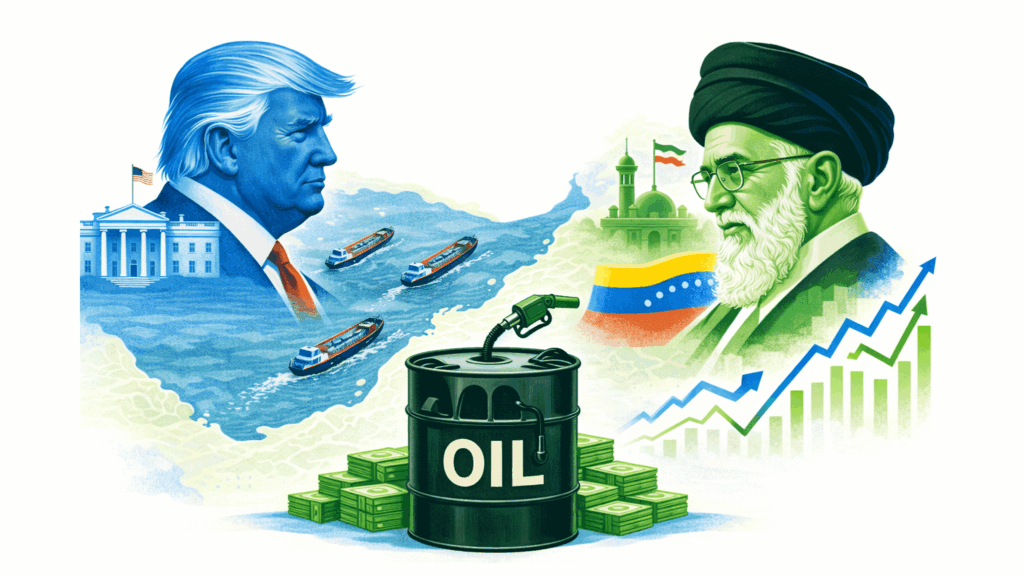
Recent events remind us that balance in energy markets can be delicate. A conflict in the Middle East and the removal of a sitting President in Venezuela resulted in sharp moves across the energy industry in early 2026. Currently, the Iran War is creating havoc in crude shipments, affecting the world. While trouble in that region is not uncommon, it is rare that major shifts occur in other regions at the same time. The removal of Nicolas Maduro in Venezuela sets the stage for a global realignment of how oil is distributed and may create lasting impacts for many countries. We try to sort out the potential winners and losers and what the next steps might look like.
The Global Energy Baseline: How U.S. Shale Changed Everything
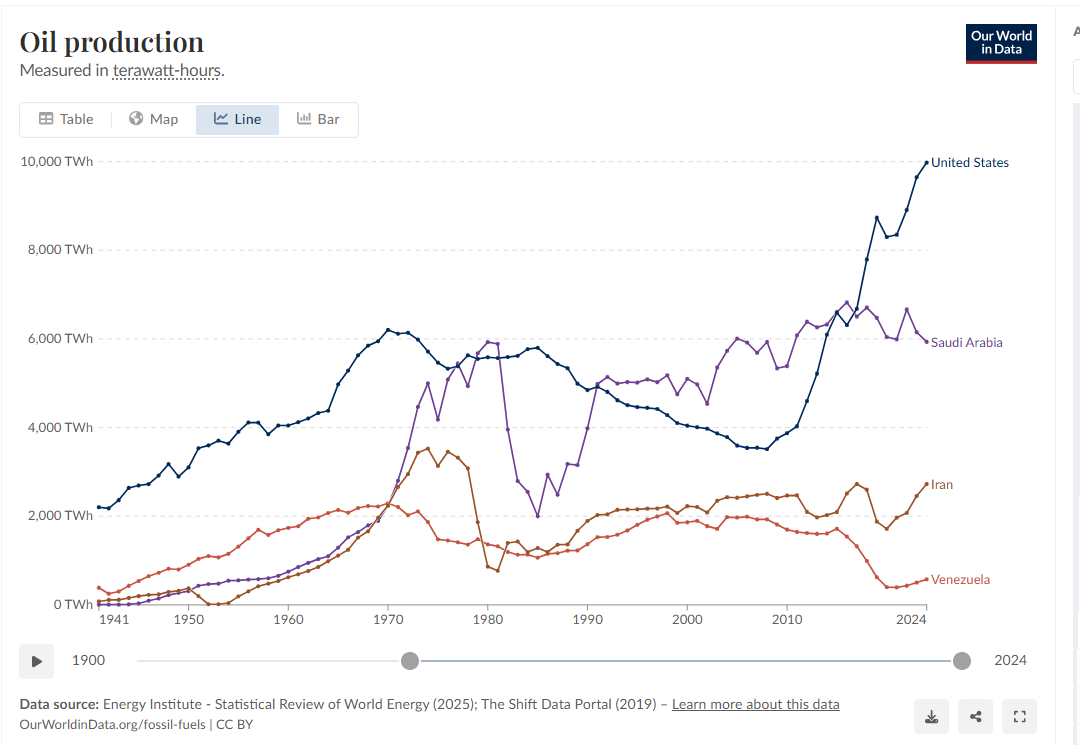
Growth in shale extraction methods pushed the United States to the top of the world’s oil-producing countries around 2019. At nearly twice the output of Saudi Arabia and Russia and four times that of Canada and China, America produces most of its own fuel and even began exporting around that time. This changed the pattern of global reliance that provided revenue to the OPEC countries, which included Saudi Arabia, Iran, Venezuela, and others. Demand continues unabated, though, with 25% more oil consumed than 20 years ago. Much of this capacity goes to fuel China, whose economy depends heavily on external sources. Cheap imports from sanctioned countries make up about 20-33% of their total. Two of their main suppliers might be adjusting their relationship with them shortly.
Venezuela: From the World’s Largest Oil Reserves to Economic Collapse
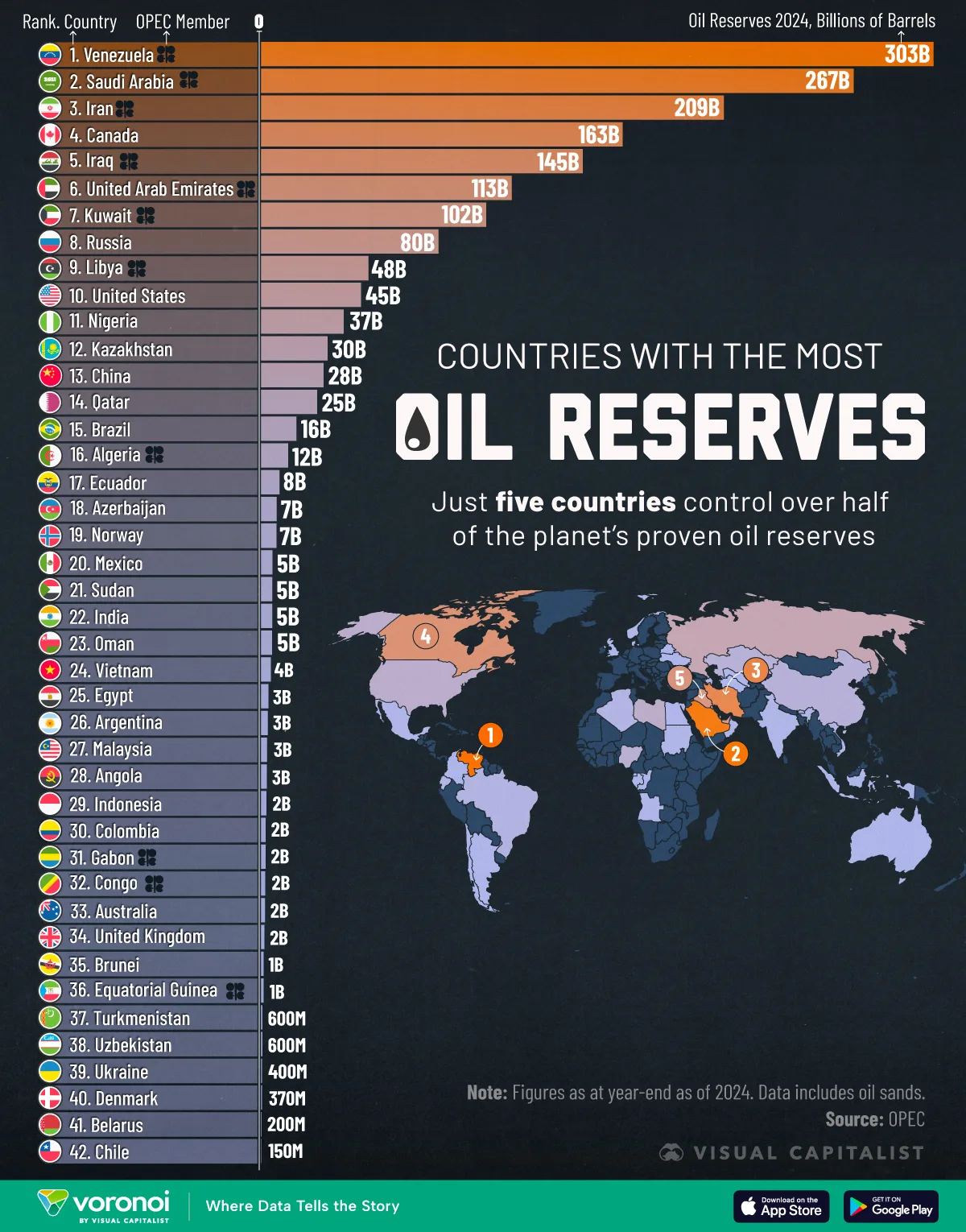
It may surprise a lot of people that Venezuela holds the world’s largest oil reserves. As chronicled in the TV show Jack Ryan, they also sit on the biggest gold deposits.
Despite this, they ranked in the bottom 20% of countries by GDP per capita. Human rights violations, narco-terrorism, corruption, and fraudulent elections all contributed to a series of sanctions beginning in the early 2000s and building through Trump’s first term. This pushed weak economic conditions from bad to worse when oil prices fell around 2016, leading to hyperinflation, food shortages, production collapse, and millions fleeing the country (25% of the population). While nationalization of their oil industry in 1976 slowed their production, companies whose assets were taken remained involved through service contracts to keep their plants running. This ended by 2007 when Hugo Chavez expropriated the remaining operations of Exxon, Chevron, and others. His replacement in 2013, Nicolas Maduro, oversaw a slow descent in production, which accelerated as infrastructure decayed and skilled workers were replaced by political patronage. Environmental damage from unchecked mining led to disastrous swaths of deforestation, mercury in rivers, and poisoned drinking water for tribes throughout their land. Mass imprisonment of political opponents, torture, and killing of protesters became commonplace. Maduro was removed on January 3, 2026, by the United States military and brought to New York to face his crimes.
Iran: Oil Revenues, Proxy Wars, and a Population Ready for Change
Much like Venezuela, Iran sits on top of massive oil reserves, which it uses to fund government activity. Increasingly, the largest share goes to the IRGC (Islamic Revolutionary Guard Corps), which pays for military projects, proxy groups, and “Supreme Leader” linked entities. Projects of theirs include missile development, drones, and their nuclear weapons programs. Sending money to militias such as the Houthis, Hezbollah, and Hamas to project influence in the Middle East is another core purpose. Lastly, reports of huge wealth accumulated by the family of Khamenei, including European mansions and hundreds of millions stashed in foreign banks, appear to be a landing spot for significant revenue. Naturally, these actions also led to sanctions, which devastated their economy, led to 40%+ inflation, and contributed to energy and water shortages.
Unlike many repressive regimes, education is valued highly in the country, and both men and women read and write with high literacy rates. English is taught in many schools starting at the age of 12-13. This knowledge is used by many to access outside social media, foreign news, and satellite TV through VPNs and encrypted apps. This leads to great awareness of the repressive nature of their country and rejection of the Islamic Republic in its current form, according to GAMAAN (the Group for Analyzing and Measuring Attitudes in Iran). Their anonymous surveys show huge support for democracy at 89% and significant blame for poverty and isolation due to proxy funding of groups like Hezbollah and Hamas. This knowledge base could be instrumental in their recovery through normalized relations with the West.
The Strait of Hormuz: Why 21 Miles Could Shake the World Economy
Both Venezuela and Iran successfully ran so-called shadow tanker fleets to evade sanctions. Much of this oil went to China at deep discounts. Seizures of these ships from Venezuela severely disrupted this flow, and both the vessels and their contents could become property of the US Treasury. Following the capture of Maduro, the interim government agreed to transfer 30-50 million barrels for sale to the US. The $500 million in proceeds from this went back to them to finance approved expenditures. This arrangement gives the US more influence on their distribution and is expected to generate as much as $5-10 billion annually. Importantly, Venezuela can now navigate its ships freely to US refineries. This benefits them as they receive the market price instead of discounted sales for illicit trafficking. Encouragement for Exxon and other wary former stakeholders to invest with their former partner is not yielding commitments thus far.
The Iranian situation is more complicated for now. Despite the war, reports indicate that their tankers continue to take crude from local ports to China. This keeps revenue flowing to the current regime. At the same time, the IRGC is threatening other ships traversing the Strait of Hormuz, a 21-mile (39 km) chokepoint connecting the Persian Gulf to the Gulf of Oman. With 76% of the world’s supply (outside of intra-country movement) seaborne, 90% of that passes through the checkpoints listed below.
| Location | 2025 H1 Volume (mb/d) | % of World Maritime Oil Trade |
|---|---|---|
| Strait of Malacca | 23.2 | 29.1% |
| Strait of Hormuz | 20.9 | 26.2% |
| Cape of Good Hope | 9.1 | 11.4% |
| Danish Straits | 4.9 | 6.1% |
| Suez Canal & SUMED Pipeline | 4.9 | 6.1% |
| Bab el-Mandeb | 4.2 | 5.3% |
| Turkish Straits (Dardanelles) | 3.7 | 4.6% |
| Panama Canal | 2.3 | 2.9% |
Source: Visual Capitalist — World Oil Chokepoints, 2025 H1 data
Almost a quarter of all volume passes through this strait in particular. Unfortunately, bypassing the location is difficult as it covers the exit point to the Persian Gulf, effectively trapping fuel from Iraq, Kuwait, Qatar, UAE, and parts of Saudi Arabia. Coalition forces could target Kharg Island, responsible for 90% of Iranian exports, or interdict their ships. Possible reasons to avoid this include the price shock it could cause, the potential to bring China into the conflict, and preserving the infrastructure for the future benefit of the Iranian people. Strikes from Iran on passing vessels continue with over a dozen hit thus far, all but halting commercial traffic through the strait.
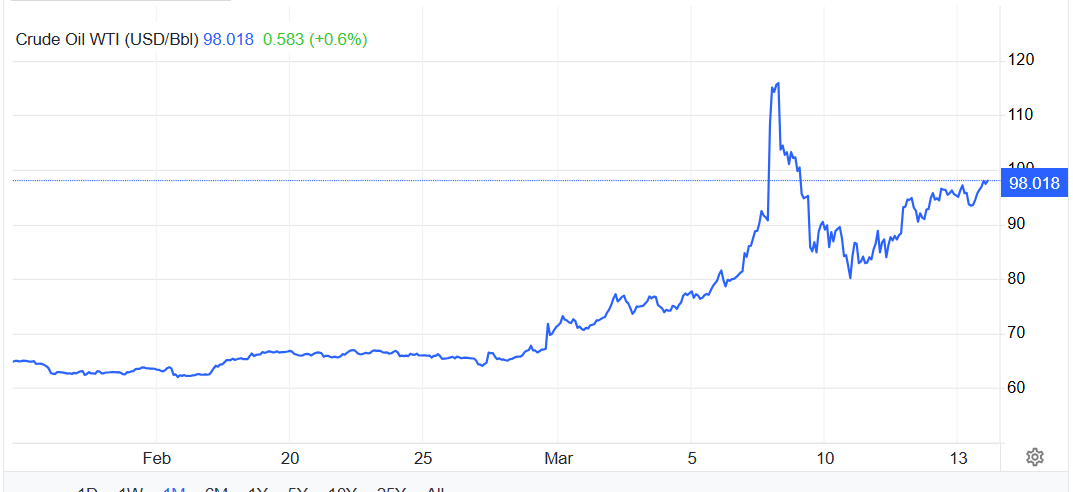
Initial price shocks at the beginning of the conflict faded quickly but appear to be climbing again. New problems, including the cost of insuring tankers, dwindling storage in the Gulf Region, and increasing competition for oil from other regions, persist. Political pressure to end the war quickly will grow with higher prices. Talks of releasing strategic reserves to offset lost supply continue in earnest.
Venezuela After Maduro: What the U.S. Deal Means for Oil Markets
By recalibrating the relationship between Venezuela and the United States, the Trump administration is removing illicit energy supplies from multiple adversarial governments, including China and Cuba. Gulf Coast refineries, built to handle their heavy crude, receive the ships and can direct the proceeds of the finished product. This is putting immense pressure on Cuba, which is almost entirely dependent on Venezuela for its energy needs. If that government falls, two nearby governments, hostile to the United States, might fall. In the meantime, this new energy supply might be redirected to friendly partners. With further sanctions relief and potential for open trade, both countries could benefit greatly.
Iran’s Oil: China’s Discount, India’s Risk, and the Price Shock Threat
Whatever happens in Iran, they will likely continue to supply China with energy. Current estimates of $8-$15 per barrel savings from buying sanctioned crude will probably disappear if a new government is elected. Despite reserves built over the years, this will impact their GDP numbers. Other large importers, such as India, might suffer from paying market prices as well.
A protracted battle and prolonged closure of the Strait of Hormuz could still send costs much higher. While the United States produces most of its own energy, commodity prices reflect the worldwide supply/demand balance. Some regime oil infrastructure is damaged, but this affects mostly the supply as opposed to refining capacity. This is more easily repaired. If production facilities get hit, it might take much longer to restore the same levels of export. The best-case scenario for all but the IRGC is a quick resolution to the conflict and normalized trade relations with the world.
Long term, if the stated goals are achieved, a peace dividend might lower energy prices for everyone. This would help developing countries, the burgeoning AI industry, and serve as a “tax cut” for everyone.
Conclusion: Trump’s Gamble and What It Means for the World
Just as in trading, taking huge risks can result in big rewards or massive failure. Donald Trump is taking chances that few American Presidents or any world leaders would take. The result will cement him as one of the most consequential or disastrous Commanders-in-Chief to ever hold the office. If he succeeds, China and Russia might be less inclined to invade their neighbors, peace in the Middle East might become a reality, and energy might trade freely without restriction around the world. If it fails, the war could spread, economies will be impacted, and energy prices will soar. For everyone’s sake, let’s hope it goes well.
Frequently Asked Questions
What is the Strait of Hormuz, and why does it matter for oil prices? The Strait of Hormuz is a 21-mile chokepoint connecting the Persian Gulf to the Gulf of Oman. It carries roughly 26% of all world maritime oil trade — about 20.9 million barrels per day — making it the single most critical bottleneck in global energy supply. Any disruption to traffic through the strait immediately affects crude prices worldwide.
Does Venezuela have more oil than Saudi Arabia? Yes. Venezuela holds the world’s largest proven oil reserves, surpassing Saudi Arabia. However, decades of nationalization, sanctions, mismanagement under Hugo Chavez and Nicolas Maduro, and infrastructure decay caused production to collapse well below its potential, leaving the country in poverty despite its resource wealth.
How did Venezuela sell oil under sanctions? Venezuela operated a “shadow tanker fleet” — a network of vessels that obscured their origin and destination to move crude oil to buyers like China at steep discounts, bypassing US and international sanctions. Following Maduro’s removal in January 2026, the US began seizing these vessels and their cargo.
Why does China buy oil from sanctioned countries like Iran and Venezuela? China secures a significant portion of its energy imports from sanctioned suppliers, including Iran and Venezuela, receiving discounts estimated at $8–$15 per barrel compared to market prices. This cheap energy has been an important input for China’s manufacturing-driven economy, representing roughly 20–33% of its total oil imports.
What happens to oil prices if the Strait of Hormuz closes? A prolonged closure would remove roughly a quarter of global seaborne oil supply from the market simultaneously, affecting exports from Iraq, Kuwait, Qatar, the UAE, and parts of Saudi Arabia in addition to Iran. Most analysts expect a severe price spike, though the US strategic petroleum reserve and potential production increases from other regions could partially offset the impact.
What is the IRGC, and how is it connected to Iran’s oil revenue? The Islamic Revolutionary Guard Corps is an elite branch of Iran’s military that controls a significant share of the country’s economic activity, including oil revenues. It uses those funds to finance missile and drone development, support proxy militias including the Houthis, Hezbollah, and Hamas, and enrich entities connected to Iran’s Supreme Leader.
What could a post-war Iran mean for global energy markets? A normalized Iran with a new government and lifted sanctions could re-enter global energy markets freely, increasing supply and putting downward pressure on oil prices. Analysts describe this scenario as a potential “peace dividend” for energy consumers worldwide, including developing nations and energy-intensive industries like AI data centers.
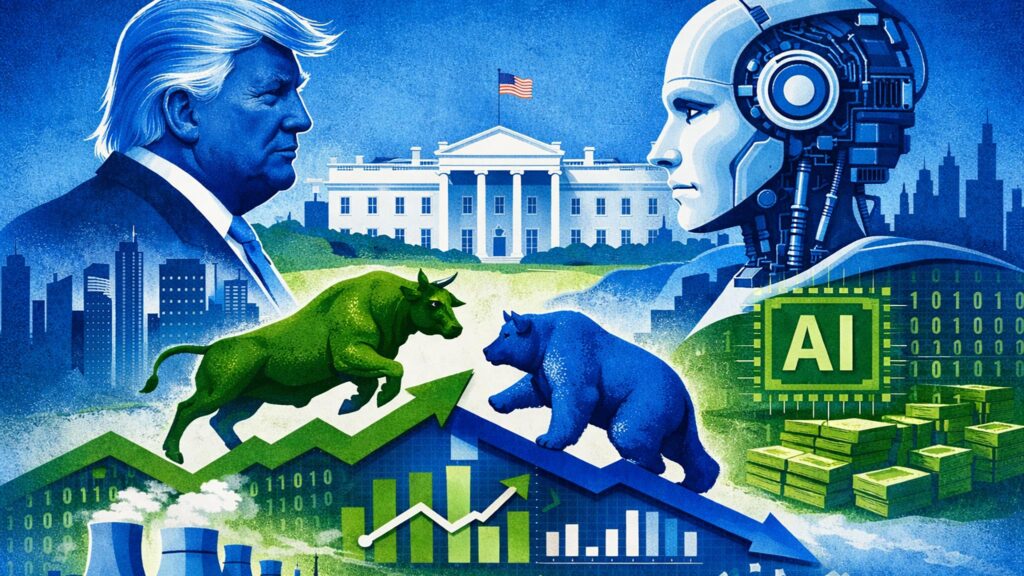
Illustration created by ChatGPT (OpenAI / DALL·E)
Related Posts

Race to Nowhere: Markets Pause Before the Next Big Move
Running on a treadmill is one of my least favorite activities: you expend a lot of energy but end up exactly where you started, only out of breath. So far in 2026, financial markets are behaving similarly. There’s intense activity, but the major indices have gone almost nowhere. As of mid-February, the S&P 500 is […]
Decoding Metals Price Action
Markets often communicate more clearly through price action than through headlines. The dramatic surge in metals contracts is sending a powerful signal, but what exactly is it telling us? Traders frequently monitor inter-market relationships for early warnings. When one asset class moves unusually, it can ripple across the system or reveal deeper structural issues. In […]
2025 in Review: Markets, Policy, and the Path Forward
History never repeats itself, but it often rhymes. This is even more so the case this year, as Trump began his second term with similar but different disruptions to the markets. Rising stocks, normalizing inflation, and the AI boom took center stage. We discuss some of the key events below and try to anticipate where […]