
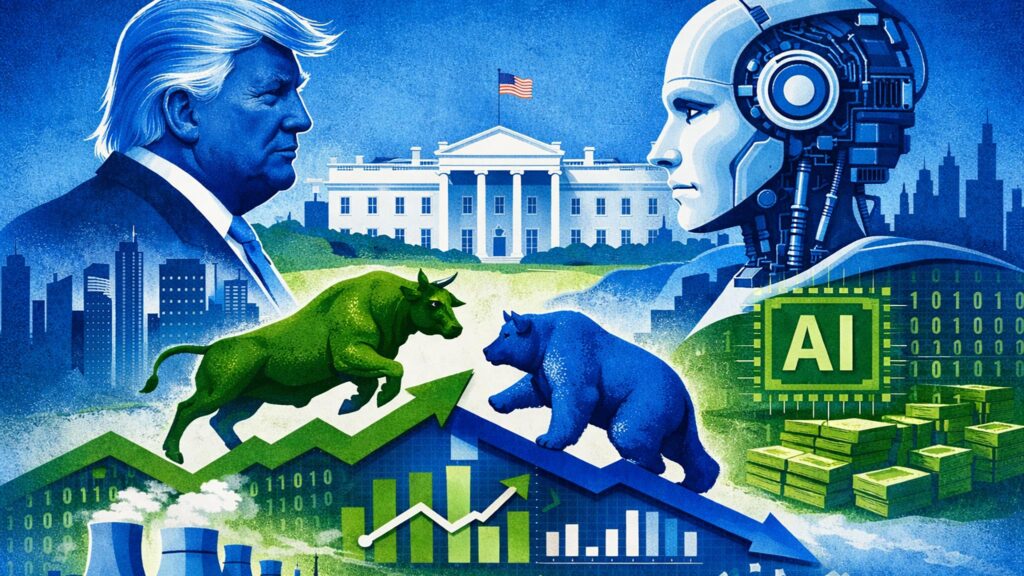
History never repeats itself, but it often rhymes. This is even more so the case this year, as Trump began his second term with similar but different disruptions to the markets. Rising stocks, normalizing inflation, and the AI boom took center stage. We discuss some of the key events below and try to anticipate where we go from here in 2026.
The Trump Election and Policy Shockwaves
We wrote about the beginning of the second Trump term in February, specifically the rapid pace at which initiatives were rolled out. Trump himself described difficulty filling thousands of government positions in his first term as he struggled to staff the vast federal workforce. This term, he immediately set out to cut headcount and get nominees approved. He succeeded in reducing the number of employees by over 200,000 from the beginning of his term and in securing swift approval for many of his nominees. Massive cuts were made to USAID, the Department of Education, and the Environmental Protection Agency, among others. Office leases, credit cards, and 29,000 grants (according to DOGE) were cancelled. The Big Beautiful Bill (BBB) codified many of these initiatives and more.
Critically, tax cuts enacted in his first term were made permanent, along with his signature “No Tax on Tips” plan, with the bill’s passage. Border security funding increased dramatically, as did budgeting for enforcement actions. This arrested the flow of illegal immigration across the border almost immediately. Significant reductions to SNAP and Medicaid were enacted, along with work requirements to access benefits. The CBO projects $1 trillion in savings over 10 years from these reforms, but deficits of $ 3T–$4 T remain due to lower tax receipts. Importantly, the reduction in government headcount and transfer payment programs should have lasting effects that will be felt in the years to come. In the near term, in echoes of the first term, tariffs drove volatility and wild market swings. Immigration and tax relief themes were also repeated.
Aiming to balance “unfairness” with trading partners, Trump announced aggressive and sweeping tariffs that applied to friends and adversaries. Citing the International Emergency Economic Powers Act (IEEPA), he issued a 10% broad baseline tariff level on all countries, plus reciprocal rates on deficit partners. The so-called “Liberation Day” caused a daily loss of almost 5% in the S&P, wiping out trillions in value. It then recovered throughout the year. Effective trade rates increased from 2-3% to around 16% on average. Currently, the US Supreme Court is deciding if the orders were issued legally. If they reverse the decision, over $200 billion in tariffs might need to be returned, which will cause havoc across equity and bond markets.
The AI Revolution as a Parallel Economic Force
Competing with policy and sentiment, the breakthrough in AI computing, allowing widespread adoption, continues to ripple through the economy. Companies like Nvidia and Palantir saw their market capitalizations explode. NVIDIA became the world’s most valuable company and first to hit $5 trillion in value (now slightly lower). Jensen Huang, CEO of Nvidia, explains that in the past ten years, they found a way to increase computing speeds by 100,000 times. This drastically altered the previous pace as described by Moore’s Law, which originally estimated a doubling of processing power each year (later revised every two years). He anticipates similar speed gains over the next decade.
We see some of the gains in efficiency already. A pathologist’s job of reading medical scans is quickly shifting to helping diagnose the disease already identified by AI. In finance, we discussed how quickly new strategies and ideas can be implemented in our article about the evolution of trading. Writing is showing improvements across the board as articles like this are put through a grammar check. Of course, schools struggle with papers written entirely by computers instead of students. As always, each new step in technology comes with new risks.
Inflation, Monetary Policy, and Labor Trends
Despite the worries about tariffs, inflation levels returned closer to the long-term average of 2%. As fears of these looming price spikes ebbed, official numbers beat virtually all GDP forecasts. The Fed played its hand cautiously with only three cuts in 2025, all occurring near the end of the year. They expect only one additional cut in 2026, keeping interest levels higher than most of the previous decade, where sub-1% was typical. Consumer sentiment is declining, yet reentrants drove almost all the additional unemployment numbers. Note that these numbers only reflect people who want and are looking for a job. The Fed will be watching hiring numbers closely to see if economic activity begins to ebb too quickly
Looking Forward: Technology, Energy, and Structural Change
Data centers of the future will require massive energy support. Jensen Huang thinks much of the AI development in the US is due to cheaper energy prices recently. This must continue. Small nuclear modules that could power small cities or large server clusters seem to be a likely trend. Self-driving cars became a reality this year and will only get closer to full autonomy without supervision. Tesla is one of the largest users of Nvidia’s new chips, and its Cortex AI supercluster uses data from the millions of Teslas sold to continuously iterate. For an aging population in the US and elsewhere, this could provide mobility and freedom that did not seem possible only a few years ago. More companies will be created, much like the internet boom, to take advantage of these new possibilities. It is very possible that the excitement will overshoot its mark, and we will see a pullback once the exuberance wears off.
Final Thoughts: Politics, Markets, and 2026 Outlook
The second year of Trump’s first term included the Russia investigation, mid-term losses, and ongoing trade wars. This time, Trump implemented many of his controversial policies immediately upon taking office. This might help lessen the impact for the 2026 election season. The economy is likely to be the main driver of sentiment for the year, and expectations for government policy will change accordingly. Both parties will do what they can to blame the other for any hiccups in growth. Ongoing talks suggest a possible resolution of the Ukraine-Russia war. Its resolution might further reduce energy prices. Trade agreements should also be finalized. This might push more manufacturing back to the US mainland and away from countries like China. Even with all these moving parts, Fed policy and AI could both be the stories of 2026. Overall, the policies introduced this term and their impacts seem like those of the first term, but done more efficiently. I am looking forward to 2026 to see if the rhyming continues.
Illustration created by ChatGPT (OpenAI / DALL·E)
Related Posts
Iran, Venezuela, and the New Global Oil Order
Recent events remind us that balance in energy markets can be delicate. A conflict in the Middle East and the removal of a sitting President in Venezuela resulted in sharp moves across the energy industry in early 2026. Currently, the Iran War is creating havoc in crude shipments, affecting the world. While trouble in that […]
Decoding Metals Price Action
Markets often communicate more clearly through price action than through headlines. The dramatic surge in metals contracts is sending a powerful signal, but what exactly is it telling us? Traders frequently monitor inter-market relationships for early warnings. When one asset class moves unusually, it can ripple across the system or reveal deeper structural issues. In […]
The Bankruptcy Cycle Returns: Delayed Failures and the Cost of Easy Money
Proper forest management requires clearing dead brush, protecting high-risk areas, and conducting controlled burns. As January 2026 approaches, marking the one-year anniversary of the devastating Southern California wildfires that destroyed over 16,000 structures, we examine the mistakes made and how those lessons apply to the financial markets. Much like forest fires, risk can be mitigated […]